MERCOSUR, CETA: The “Providure” Scam

In BAM!, Corinne Lalo[1] exposes the underhanded tactics behind the free trade agreements signed by the EU.
By comparing the treaty signed with Canada (CETA) in 2016 and the one signed with Mercosur (EMPA/iTA) in 2026, she exposes a veritable anti-democratic power grab! A temporary measure that lasts—the “providure.”
January 17, 2026 will be remembered as the dark day when the death knell was sounded for the French way of life. Ursula von der Leyen has, in fact, signed, on behalf of the European Union, the Mercosur free trade agreement with four Latin American countries: Brazil, Argentina, Paraguay, and Uruguay.
With the Mercosur Treaty, the Eurocrats are pulling the same stunt as with CETA. It is important to note that, in all secrecy, this free trade agreement with Canada has been in effect for nine years across all EU countries, even though the parliaments of 10 countries have still not ratified it[2].
This is what is known as a “temporary measure that lasts”—or, as our Swiss friends say, a “providure.”
The anti-democratic scenario of the Mercosur Treaty is essentially the same as that of CETA. Here are the different steps that establish this “providure”:
Step 1
Negotiating mandate for a text
The Commission obtains from the Council the right to negotiate a comprehensive free trade agreement. Initially, a single text is planned.
CETA: 2009
MERCOSUR: 1999
Step 2
The Commission concludes an agreement with stakeholders
CETA: September 26, 2014
MERCOSUR: December 6, 2024
Step 3
Splitting the agreement into two texts
The Commission manages to circumvent the democratic process by splitting the agreement into two parts: one is political, general in nature, and without major issues, while the other is crucial because it involves the elimination of customs duties. This is the trade section.
Why this split? Because the political part requires a unanimous vote by the member states of the European Union, while the trade part can be approved by a qualified majority vote in the Council and applies immediately and provisionally.
This provisional application is fundamental because it can last a very, very long time without any issues, since business continues as usual during that time.
That is where the “trick” lies.
Dates of the Council’s approval of the split into two texts:
CETA: July 5, 2016
MERCOSUR: December 10, 2025[3].
Here is how the Council’s website explains this sleight of hand in its typically technocratic style:
“Negotiations for an EU–Mercosur Association Agreement […] have resulted in two parallel and legally distinct legal instruments: the EU–Mercosur Partnership Agreement (EMPA), based on three pillars (political dialogue, cooperation, and trade), and the Interim Trade Agreement (iTA), comprising trade and investment commitments, which will apply prior to the entry into force of the EMPA[4].”
It is this so-called “interim” agreement that allows for the immediate elimination of customs duties and thus permits the entry into Europe of low-quality but cheap agricultural products. All European farmers will face unfair and distorted competition. Many will not be able to survive and will be doomed to disappear sooner or later.
Step 4
Council gives the Commission the green light to sign
This signing authority granted to the Commission is accompanied by authorization for provisional application.
CETA: October 28, 2016.
MERCOSUR: January 9, 2026[5].
Step 5
Signing of the agreement by the Commission President
CETA: October 30, 2016 (Manuel Barroso)
MERCOSUR: January 17, 2026 (Ursula von der Leyen)
Step 6
Consent vote by the European Parliament to ratify the agreement with provisional application of the trade provisions
CETA: February 15, 2017
MERCOSUR: date currently unknown
This so-called “consent vote” is expected to take place between March and May 2026. In practice, the agreement is submitted to the Parliament, which must approve it by a simple majority of the members present on the day of the session. Therefore, half plus one of the members must vote “yes” for the agreement to be considered ratified at the European level.
If the vote is positive, the agreement must then return to the Council so that it can officially adopt the decision to conclude the agreement.
If this consent is not obtained—which is possible given the current balance of power—then the MERCOSUR agreement will be blocked and, in theory, according to the Treaty on the Functioning of the European Union (TFEU, Article 218), it cannot be applied, even provisionally.
This “non-consent” by the European Parliament has already occurred in the past, notably for the SWIFT (2010) and ACTA (2012) agreements. ACTA was definitively shelved, while SWIFT had to be rewritten before being approved by “Parliamentary consent.”
A last-minute move by the Parliament could involve requesting that the Court of Justice of the European Union be asked to rule on the legality of the “splitting into two texts” of the Mercosur agreement.
If this referral is voted on January 21, it will significantly delay the process and should, in theory, prevent the provisional application of the agreement until Parliament votes on whether or not to give its consent.
However, given the anti-democratic excesses of the pro-European machine, nothing can be taken for granted anymore.
Step 7
Provisional entry into force of the agreement
CETA: September 21, 2017
MERCOSUR: in theory, the first day of the second month following “ratification” by the European Parliament.
Step 8
Vote by all national parliaments for permanent rather than provisional application
CETA: This vote has still not taken place ten years after the Commission signed the agreement, which does not prevent the treaty from remaining in provisional application. According to the Commission’s website, “The Parliament gave its consent on February 15, 2017. On September 21, 2017, the agreement entered into force on a provisional basis.
CETA will enter into force fully and definitively once all Member State parliaments have ratified the Agreement.”
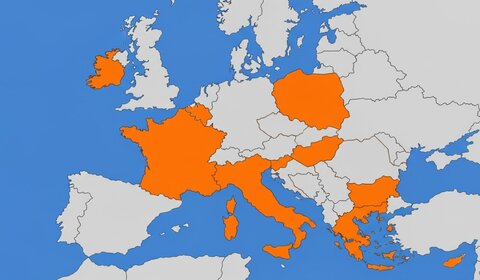
Ten countries have still not ratified CETA through a parliamentary vote: France, Belgium, Italy, Poland, Greece, Ireland, Hungary, Bulgaria, Slovenia, and Cyprus[6].
MERCOSUR: dates currently unknown. The various ratifications do not matter since the treaty will already be in effect if the European Parliament has given its consent (see step 6). Mercosur will enter into full and definitive force once all member states’ parliaments have ratified the Agreement. Like CETA, this process could take nine years or… an infinite amount of time—the “providure”!
The 10 countries that have not ratified CETA but are subject to it anyway
Ireland, France, Belgium, Italy, Slovenia, Hungary, Poland, Greece, Bulgaria, Cyprus |
An anti-democratic power grab
It is worth noting in passing that the European Union is no stranger to anti-democratic power grabs. Indeed, while the Council states on its own website that the European Parliament votes before the agreement is ratified by partner countries, with Mercosur, it will be after the signing[7]! This speaks volumes about the regard in which this pseudo-Parliament is held, as it does not even have the power to initiate legislation. That privilege is reserved solely for the Commission, composed of unelected Eurocrats.
Let us not worry about Ursula von der Leyen’s future. Once she has signed the Mercosur agreement, she will be able to land a job in international finance, just like her predecessor Manuel Barroso, who signed CETA. He went straight into a cushy job at Goldman Sachs and then took the helm of Gavi, a public-private partnership founded by Bill Gates in Davos. It is precisely Gavi (the Global Alliance for Vaccines and Immunization) that we found at the heart of the catastrophic and scandalous handling of Covid.
Corinne Lalo for BAM!.
Illustration by BAM!
[1] Corinne Lalo (@corinne_lalo on X), a freelance journalist, former senior reporter (notably at TF1), and author of several investigative books, has helped expose or shed light on several major scandals over the past 40 years (the Chernobyl cloud, contaminated blood, Mediator, endocrine disruptors, H1N1, Covid/"vaccines"…)
[2] CETA Agreement: Overview of the FTA table
[3] MERCOSUR Agreement: split into two legal texts, one political and the other economic and commercial
[4] EU-Mercosur: Council gives green light to signing of the Comprehensive Partnership and Trade Agreement
[5] EU-Mercosur: Council gives green light to signing of Comprehensive Partnership and Trade Agreement
[6] CETA Agreement: Overview of the FTA table
[7] Infographic: EU trade negotiations - Consilium